
How the World Bank transferred the colonial governments’ debts onto the newly independent States.
By Eric Toussaint (19 Sept 2026) https://www.cadtm.org/The-debts-of-colonization:
It was not only arbitrary borders, extrovert economies and institutions fashioned by colonial domination that post-war decolonization bequeathed upon the newly independent States. In many cases, it also passed on to them debts incurred by the colonial powers to administrate, exploit and consolidate their dominance. This transfer is one of the least-known aspects of the history of international debt. Yet it is in flagrant contradiction with peoples’ right to self-determination and with the principles of international law which preclude a people from bearing the cost of its own colonization. In examining the loans granted by the World Bank to the colonial empires of Belgium, France and Britain, and how they were transferred to the newly independent States, this article shows that these loans fall under the category of odious debt and should be declared null and void. More broadly, it is an invitation to open up the debate over the reparations due to peoples who suffered at the hands of colonization.
The World Bank’s odious debts to colonial powers
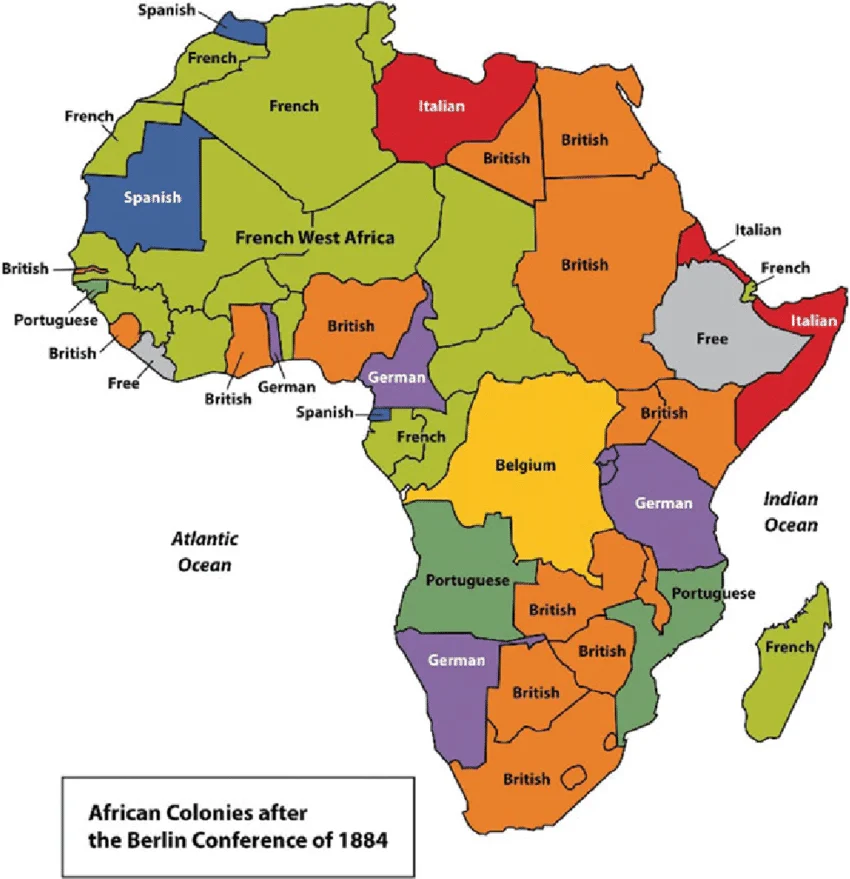
Ten years after it was founded in 1944, there were only two members from Sub-Saharan Africa in the World Bank: Ethiopia and South Africa (where the black majority was oppressed by a white minority of colonialists from Europe). Almost all the populations of Africa were still under colonial domination. When the World Bank (and the IMF) were founded, over 90% of the peoples and territories of the African continent were under colonial rule (see Box at the end of the article on the African territories that were colonized in 1944). In violation of peoples’ right to self-determination, the World Bank granted loans to France, Belgium and Great Britain to finance projects in their colonies. Peoples’ right to self-determination is a principle recognized by various international instruments (such as the 1945 Charter of the United Nations Organization, the UN General Assembly’s Declaration on the Granting of Independence to Colonial Countries and Peoples of 14 December 1960, the two international Covenants relating to human rights adopted in 1966, the United Nations Declaration on Friendly Relations adopted on 24 October 1970) and by numerous regional instruments.
The colonies concerned by World Bank loans were, for Belgium, the Belgian Congo, Rwanda and Burundi; for Great Britain, East Africa (including Kenya, Uganda and the future Tanzania), Rhodesia (now Zambia and Zimbabwe), and also Nigeria, to which should be added British Guyana in South America; for France, Algeria, Gabon, French West Africa (Mauritania, Senegal, French Sudan (that then became Mali, Guinea, Côte d’Ivoire, Niger, Upper Volta – now Burkina Faso – and Dahomey – now Benin).
As the Bank’s own historians concur:
“The loans, which served to alleviate the dollar shortages of the European colonial powers, were largely directed to colonial interests, especially mining, either through direct investments or indirect assistance, as in the development of the transport infrastructure related to mining.” [1].
These loans enabled the colonial States to strengthen the yoke they held on the peoples they had colonized, thereby violating the peoples’ right to self-determination. That right placed the colonizer under a dual obligation: to abstain from any cooperation, military or otherwise, aimed at repressing a national liberation movement and the duty to endorse decolonization and self-determination by providing all necessary diplomatic or material support.
The loans granted by the World Bank contributed to supplying the metropolitan centres of the colonial powers with minerals, agricultural produce and fuel. Before the World Bank started its activities, during the Second World War, it was with uranium mined in the Congolese province of Katanga that the United States made the atomic bombs that destroyed the populations of Hiroshima and Nagasaki in Japan in 1945. To thank them for the uranium, after the Second World War the United States cancelled Belgium’s debt towards them.
Odious colonial debt imposed on the young independent nations
When the afore-mentioned colonies became independent, the countries of the North that held sway in the World Bank all agreed to make them bear the burden of debt contracted under colonial rule.
The example of Mauritania stands as proof. On 17th March 1960, France guaranteed a loan of 66 million dollars contracted by the Société anonyme des mines de fer de Mauritanie (the Mauritanian Iron Mines Company, known by the French acronym MIFERMA). Mauritania only remained a French colony for a very short period after this, as its independence was proclaimed on 2th November of the same year. The loan was to be repaid between 1966 and 1975. According to the Bank’s annual report, six years later independent Mauritania owed it 66 million dollars. [2] The debt granted at the request of France while Mauritania was still its colony had become a debt owed by Mauritania, a few years later. The Bank generalized this procedure whereby debt contracted by a colonial power was transferred to the newly independent State.
When Belgium was forced, by massive popular mobilization, to recognize Congo’s independence on 30 June 1960, it tried to impose on the Congolese government led by Patrice Lumumba the debt that Belgium had accumulated throughout the 1950s to exploit the “Belgian” Congo. To that were added considerable amounts of other debts that Belgium had run up as a colonial power, from other creditors complicit in the exploitation of the Congo. Lumumba refused. This was one of the reasons that inclined Belgium to take a direct role in Lumumba’s assassination in January 1961.
In the case of the Belgian Congo, the millions of dollars loaned by the World Bank for projects decided by the colonial power were practically all spent by the colonial administration of the Congo in the purchase of products exported from Belgium. The Belgian Congo received a total of 120 million dollars in loans (in 3 tranches) of which 105.4 million were spent in Belgium. [3] For the government of Patrice Lumumba, it was inconceivable that this debt be repaid to the World Bank when it had been contracted by Belgium to exploit the Belgian Congo. Things changed in 1965: following Mobutu’s military coup, the Congo acknowledged its debt towards the World Bank. As a reward, the dictator Mobutu was financed systematically by the World Bank until the early 1990s. The country’s debt under the iron rule of Mobutu increased enormously.
Cancellation of the debts of African colonies and Poland under the Treaty of Versailles (1919)
Political independence cannot mean that there is an obligation to repay the cost of the one’s own domination.
This is why, when Poland was restored to the status of an independent State after the First World War, it was decided that the debts contracted by Germany to colonize the part of Poland that it had taken over would not be incumbent upon the new independent State.
The Treaty of Versailles of 28 June 1919 stipulated:
“There shall be excluded from the share of such financial liabilities assumed by Poland that portion of the debt which, according to the findings of the Reparation Commission referred to in the above-mentioned Article, arises from measures adopted by the German and Prussian Governments with a view to German colonization in Poland.” [4]
.
The Treaty provided that creditors who had loaned money to Germany for projects on Polish territory could only reclaim what was owed them from that country and not from Poland.
Under the Treaty of Versailles, the German Empire lost territories it had colonized in Africa, and the debts of those colonies were cancelled. The German party was not happy, and tried to persuade the victorious powers to renounce this debt cancellation since it implied that Germany would have to repay the debt.
The Allies replied:
“The colonies should not bear any portion of the German debt, nor remain under any obligation to refund to Germany the expenses incurred by the Imperial administration of the protectorate. In fact, it would be unjust to burden the natives with expenditure which appears to have been incurred in Germany’ s own interest, and that it would be no less unjust to make this responsibility rest upon the Mandatory Powers which, in so far as they may be appointed trustees by the League of Nations, will derive no benefit from such trusteeship.” [5]
Under the Treaty of Versailles of 1919, these colonies were transferred to three European colonial powers: Great Britain, France and Belgium, which were among the ‘victors’ of the First World War and thus expanded their colonial empires at the expense of the peoples of Africa.
Alexander-Nahum Sack, who theorized odious debt, explains in his legal treatise of 1927:
“When the government contracts debts in order to enslave the population of part of its territory or to colonize that population through expatriates of the dominant nation, etc., these debts are odious to the indigenous population of this part of the debtor State.” [6].
That should have applied across the board to all loans granted by the Bank to Belgium, France and Great Britain for the development of their colonies. Consequently, the Bank has acted in violation of international law by making the newly independent States bear the burden of debts contracted by their colonizers. The World Bank, under the direction of the United States and the European colonial powers, has committed an act that cannot remain unpunished. Such debts are null and void and the Bank must answer to the courts for its actions. The States that have been victims of these infractions must demand reparation and use the amounts obtained to repay the social debt due to their people.
Reparations should be demanded of the former colonial powers notably through the International Court of Justice at The Hague. Moreover, citizens’ associations representing victims can take the World Bank to court, either in their own country or in a country where the Bank is represented or where it has granted loans..
Since 1950s and 60s, WB and IMF have acted as bailiffs on behalf of former private creditors
I give a detailed analysis of this in my book The Debt System: A History of Sovereign Debts and Their Repudiation published in 2017 (2019 for the English version). From the 19th century until the Second World War several governments of former Spanish colonies in Latin America suspended payment or repudiated their debts considered as odious, illegal and/or illegitimate. Such was the case of Mexico in 1861, 1867 and 1883, of Guatemala in 1829, Peru in 1886, Costa Rica in 1920, Cuba in 1902 and 1934, and of Brazil from 1932. The United States also repudiated debts considered odious and illegitimate in the 1830s, 1865, the 1870s and in 1898. In 1918 Soviet Russia repudiated debt contracted by the Tsarist regime. As well as the afore-mentioned cancellation of debt contracted by Germany to colonize Polish and African territory in 1919, in 1920-1921 there was the Bolshevik government’s cancellation of the debt of the three Baltic States which had been part of the Tsarist empire, and also that of Poland, Persia and Turkey. These various cancellations, suspensions of payment and repudiations gave rise to numerous conflicts, arbitrations and unilateral actions. It was then that the legal doctrine of odious debt, mentioned above, made its entrance. Clearly, the World Bank and the IMF acted to restore the power of creditors and tried to persuade different States that the doctrine of odious debt belonged to a bygone era.
As Julia Juruna writes in the columns of the French monthly, Le Monde diplomatique, the first time that a member country requests a loan from the IMF or the World Bank, they lay down two preliminary conditions: the payment of outstanding international debts and “adequate” compensation for nationalized foreign assets. [7] According to World Bank historians Mason et Asher, the demand that former debts should be paid off has revived decades-old litigation between certain Latin-American governments and their Western creditors, sometimes going as far back as the 19th century! [8]
Julia Juruna, using their research, indicates that:
“The most striking case was no doubt that of Guatemala, where the World Bank brought up the matter of payment of bonds issued in 1829. The country was only able to obtain World Bank loans once the Guatemalan courts had ruled in favour of the bearers of these bonds, over a hundred years old.”
The refusal of the World Bank and the IMF to comply with the requests of the UN regarding Portugal and South Africa
Let us recall that until the 1970s, Portugal hung on to its colonial empire by force and in defiance of UN resolutions; and that South Africa maintained the apartheid regime right up until the 1990s. In order to carry out their crimes, both Portuguese and South African governments enjoyed the complicity of the World Bank, the IMF, Washington, European former colonial powers and big private corporations.
All this, notwithstanding the condemnations expressed by the UN. From 1961, when most of the colonial countries had obtained their independence and become members of the UN, the General Assembly repeatedly adopted resolutions condemning the apartheid regime in South Africa, and the government of Portugal for maintaining its yoke over several countries in Africa and Asia. In 1965, seeing that the Bank and the IMF persisted in their financial and technical support of these regimes, the UN formally requested:
“To all the specialized agencies of the United Nations and in particular the International Bank for Reconstruction and Development and the International Monetary Fund […] to refrain from granting Portugal any financial, economic or technical assistance as long as the government of Portugal fails to implement General Assembly resolution 1514 (XV) and to renounce its colonial policy, which constitutes a flagrant violation of the provisions of the UN Charter”. [9].
The UN General Assembly did the same thing concerning South Africa.
Faced with these injunctions, the leadership and directors of the World Bank met to decide what stance to take, and the majority of executive directors decided to carry on with the loans. The justification they invoked was that Article 4, section 10 of the Bank’s statutes prohibited it from entering into politics! All the most industrialized countries, backed by a certain number of Latin-American countries, voted in favour of continuing with the loans. In 1966, the Bank approved a loan of 10 million dollars to Portugal and 20 million for South Africa. Subsequently, under intensified pressure, the Bank ceased to grant further loans. Nevertheless, for over 15 years, a UN structure, the Decolonization Committee, continued to denounce the fact that the World Bank allowed South Africa and Portugal to apply for funding by the Bank for projects in other countries.
Conclusion: Political independence cannot mean the obligation to repay the cost of one’s own domination.
The legacy of colonial debts is not a mere anomaly in international financial history. It reveals the way in which relations of dominance have survived after political independence and been prolonged through the mechanisms of indebtedness. By transferring to the newly independent States the debts that had been contracted to ensure their own colonization, the World Bank and its main share-holders have violated fundamental principles of international law, in particular peoples’ right to self-determination. These claims fulfil the criteria for odious debt and should never have been imposed on newly sovereign States.
Acknowledging this historical reality is more than a moral obligation to remember. It is a demand for justice. The States concerned have grounds to claim the debts to be null and void, to demand reimbursement of the sums unduly paid and compensation for damages suffered. More generally, this story reminds us that international law cannot to be invoked selectively. The principles that allowed debts connected to German colonization to be cancelled after the First World War must equally apply to the inherited debts of the colonial empires of Belgium, France and Great Britain, and the other colonial powers.
At a time when demands for reparations for enslavement, colonization and the pillage of natural resources are gaining in legitimacy on all continents, the question of colonial debts becomes particularly relevant. To shed light on their origins, demonstrate their illegality and demand their cancellation are all part of the same struggle: that of the unfinished decolonization of the international economic and financial order.
Some facts about colonial possessions in Africa in January 1944
In January 1944, six European colonial powers (Great Britain, France, Belgium, Portugal, Spain and Italy) controlled, directly or indirectly, 90 % of African territory. Only three countries escaped legally from colonial exploitation: Liberia, Ethiopia and the Union of South Africa, the latter being governed by a white minority exercising political and economic domination over the black majority.
There follows a list of African territories subjected to European colonial domination in January 1944. The administrative designations current in January 1944 are used.
Belgium
- Belgian Congo
- Ruanda-Urundi (territory under UN mandate administered by Belgium)
France
North Africa
- Algeria
- The French Protectorate of Morocco
- The French Protectorate of Tunisia
French West Africa (FWA)
- Senegal
- Mauritania
- The French Sudan
- French Guinea
- Côte d’Ivoire
- Dahomey
- Niger
- Upper Volta
French Equatorial Africa (FEA)
- Chad
- Ubangi-Shari
- Middle Congo
- Gabon
Other continental territories
- French Cameroon (a League of Nations mandated territory)
- French Togo (a League of Nations mandated territory)
- French Somaliland
Islands
- Madagascar
- Reunion Island
- The Comores (administered from Madagascar)
Great Britain
North and North-East Africa
- Egypt (an independent kingdom under strong British control)
- Anglo-Egyptian Sudan
British West Africa
- Gambia
- Sierra Leone
- Gold Coast
- Nigeria
Mandated territories
- British Cameroons
- British Togoland
British East Africa
- Kenya
- Uganda
- Tanganyika (a League of Nations mandated territory)
- British Somaliland
Central Africa
- Northern Rhodesia
- Nyasaland
Southern Africa
- Southern Rhodesia
- Bechuanaland
- Basutoland
- Swaziland
Islands
- Mauritius
- Seychelles
- Zanzibar (protectorate)
- Pemba (protectorate)
Portugal
Continental colonies
- Angola
- Mozambique
- Portuguese Guinea
Islands
- Cape Verde
- São Tomé and Príncipe
Spain
Continental Africa
- Spanish protectorate in Morocco
- Ifni
- Spanish Sahara
◦ Saguia el-Hamra
◦ Río de Oro
Islands
- Fernando Pó
- Annobón
- Corisco
- Elobey Grande
- Elobey Chico
(Taken as a whole, these territories formed Spanish Guinea)
Italy
In January 1944, legally, Italy still claimed these colonies, but several were occupied by the Allied forces.
Colonies
- Libya (occupied by the Allies since 1943)
- Eritrea (British military administration)
- Italian Somaliland (British military administration)
- Ethiopia (independent since 1941 following the restoration of the Emperor Haile Selassie; Italian occupation was over)
Italian East Africa (Africa Orientale Italiana), founded in 1936 and composed of Eritrea, Ethiopia and Italian Somaliland, had effectively ceased to exist by January 1944.
Independent African States
- Liberia created in 1847 by former Afro-American slaves returning from the Americas
- Ethiopia that had been occupied by fascist Italy from 1936-1941
- The Union of South Africa (a dominion of the British Commonwealth) where the black majority was subjected to the rule of the white minority of European origin.
Footnotes
[1] DEVESH KAPUR, JOHN P. LEWIS, RICHARD WEBB. 1997. The World Bank, Its First Half Century, Volume 1, p. 687.
[2] IBRD (World Bank), Fifteenth Annual Report 1959-1960, Washington DC, p. 52; IBRD (World Bank), Fifteenth Annual Report 1965-1966, Washington DC, p. 79.
[3] The fact that Belgium benefitted from loans to the Belgian Congo can be deduced from a table published in the 15th Report of the World Bank: IBRD (World Bank), Fifteenth Annual Report 1959-1960, Washington DC, p. 12.
[4] Cited by Alexander Nahum Sack. 1927. Les Effets des Transformations des États sur leurs Dettes Publiques et Autres Obligations financières, (The Effects of State Transformations on Their Public Debts and Other Financial Obligations) Recueil Sirey, Paris, p. 159. In French.
[5] Treaty series, n° 4, 1919, p. 26. Cited by Sack, p. 162.
[6] Alexander Nahum Sack. 1927. p. 158. Original French text: “Lorsque le gouvernement contracte des dettes afin d’asservir la population d’une partie de son territoire ou de coloniser celle-ci par des ressortissants de la nationalité dominante, etc., ces dettes sont odieuses pour la population indigène de cette partie du territoire de l’État débiteur.” Translated by CADTM
[7] Julia Juruna, « Le Fonds monétaire et les banques privées. Le « gendarme » du grand capital » (The International Monetary Fund and private banks. The ‘gendarme’ of big capital.), Le Monde diplomatique, October 1977, p. 1, 20 et 21. (In French) Translated by CADTM.
[8] Edward S. Mason and Robert E. Asher. 1973. The World Bank since Bretton Woods, The Brookings Institution, Washington, D.C.
[9] UN Doc. A/AC.109/124 and Corr. 1 (June 10, 1965).
